Prof. Zhe Yang and Collaborators Develop Novel Covalent Organic Network Membranes for Subangstrom Precision Ion Sieving
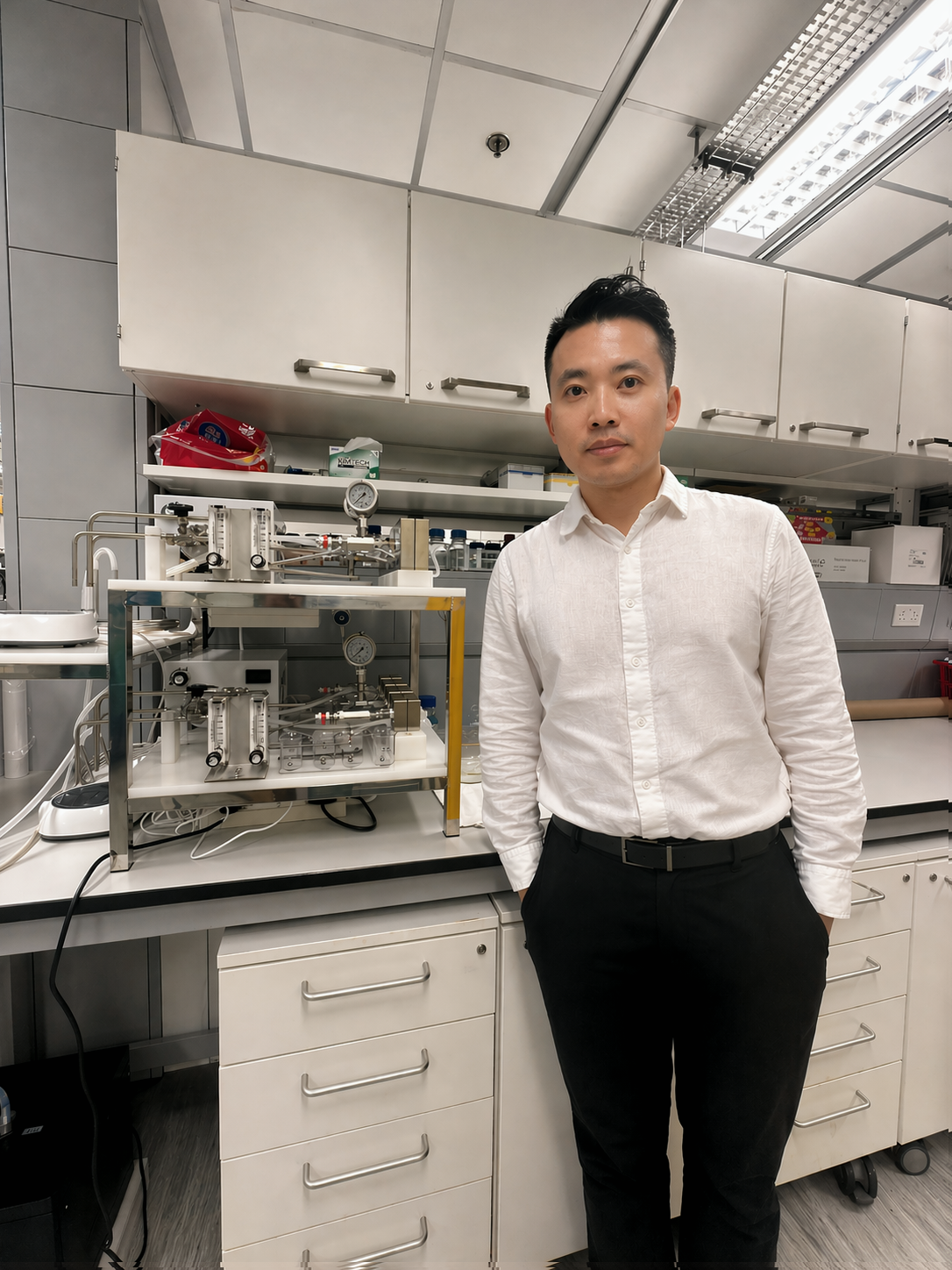
The Department’s Assistance Professor Zhe Yang and his research team, in collaboration with researchers from the East China University of Science and Technology, have developed a new class of high‑precision ion‑selective membranes that combine ultrafast ion transport with sub‑ångström sieving capability. The technology, which offers a sustainable solution for resource recovery and industrial wastewater treatment, has been publicized in the journal Science Advances in an article entitled “Macrocycle-based covalent organic networks for ultrafast sub–1-Å precision ion sieving”.
What the study has found is that by integrating macrocyclic molecular building blocks into an industrially compatible interfacial polymerization process, covalent organic network (CON) membranes with highly uniform sub-nanometer pores can be fabricated. More importantly, the unique structure enables precise separation of mono‑ and di-valent ions while maintaining an exceptionally high ion transport rate. In particular, the key breakthroughs of the technology include:
-Offering a novel fabrication strategy for ultra-thin CON membranes using a scalable interfacial polymerization process fully compatible with existing membrane manufacturing infrastructure;
-Achieving outstanding separation performance, with CON membranes exhibiting a satisfactory water permeance (up to 22.2 L m-2 h-1 bar-1) together with ultra-high ion-ion selectivity — Li+/Mg2+ and Cl-/SO42- selectivities of 82.6 and 118.1, respectively; and
-Facilitating system‑scale analysis of membrane performance for lithium extraction and ion fractionation processes, thereby demonstrating a strong potential for broad applications in resource recovery from brines and high‑salinity industrial wastewater.
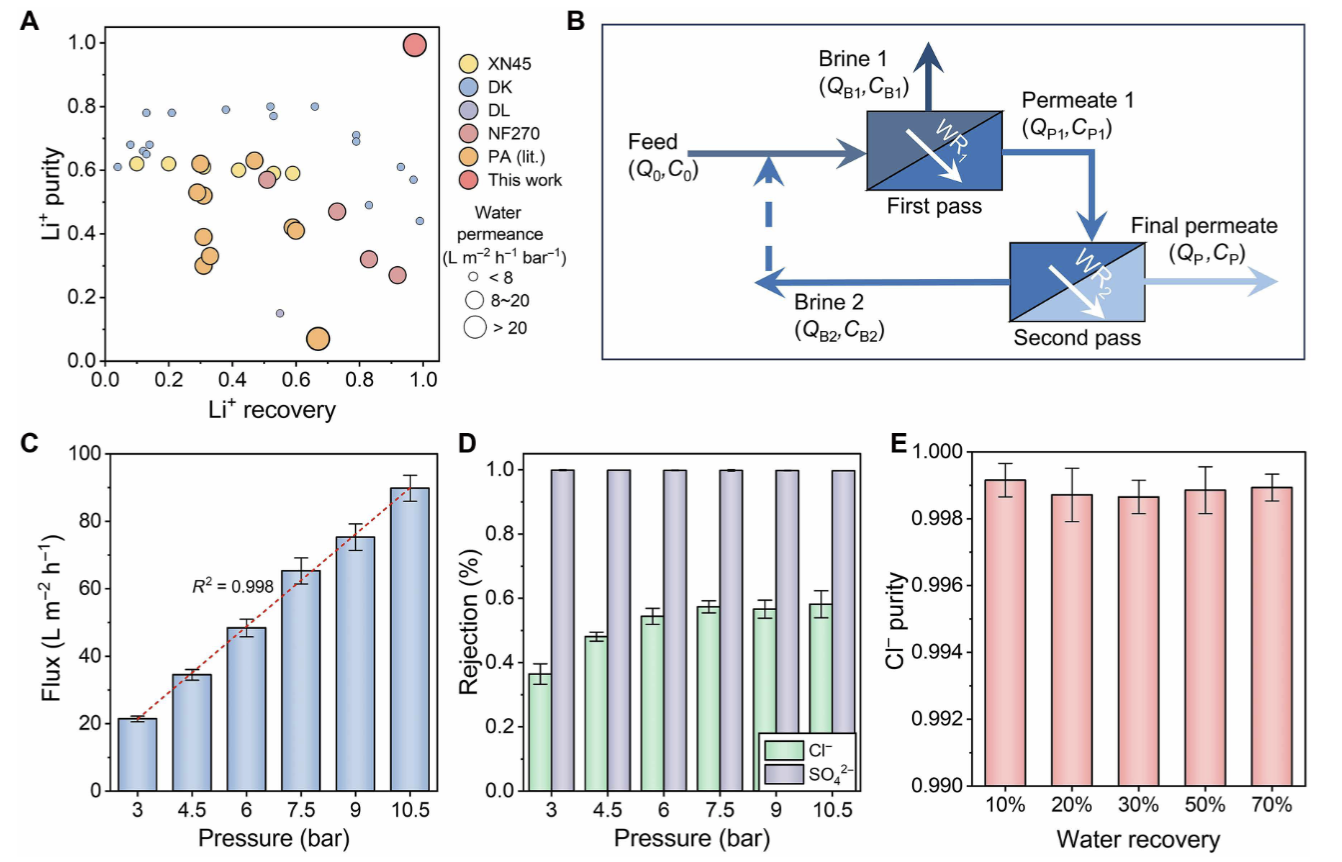
Beyond laboratory‑scale testing, the research has also further evaluated the CON membranes’ performance under process‑scale conditions, and the results show that they can significantly reduce process complexity as well as improve both product recovery and purity. This not only underscores the technology’s promise for real‑world deployment in energy‑ and water‑related industries, but also its potential to be a next‑generation platform for high‑resolution ion separation, contributing to more efficient and sustainable solutions at the water-energy nexus. Indeed, as Prof. Yang — the study’s leading corresponding author — notes, the research has deepened “our understanding of how precise molecular design can be translated into scalable membrane technologies, and by bridging materials innovation and process‑level analysis, it can benefit industries such as lithium resource recovery, sustainable energy storage, and high‑salinity wastewater treatment.”
The article can be accessed at https://www.science.org/doi/full/10.1126/sciadv.aed0804.